
Irish Sumac
A new sourness in our landscape

Sumac is most often associated with the kitchens of the Middle East. Its crimson drupes, once dried and ground, create a spice that lends brightness, acidity, and a vivid red colour to flatbreads, grilled meats, salads, and soups. For cooks from Lebanon to Turkey, Iran to Syria and Palestine, it is indispensable: as vital as salt or lemon. For many of us in Ireland, however, sumac feels like an import, a borrowed flavour, something that belongs to another cuisine and another climate.
Yet, as everything with Irish food and food in Ireland, the story is more complicated.
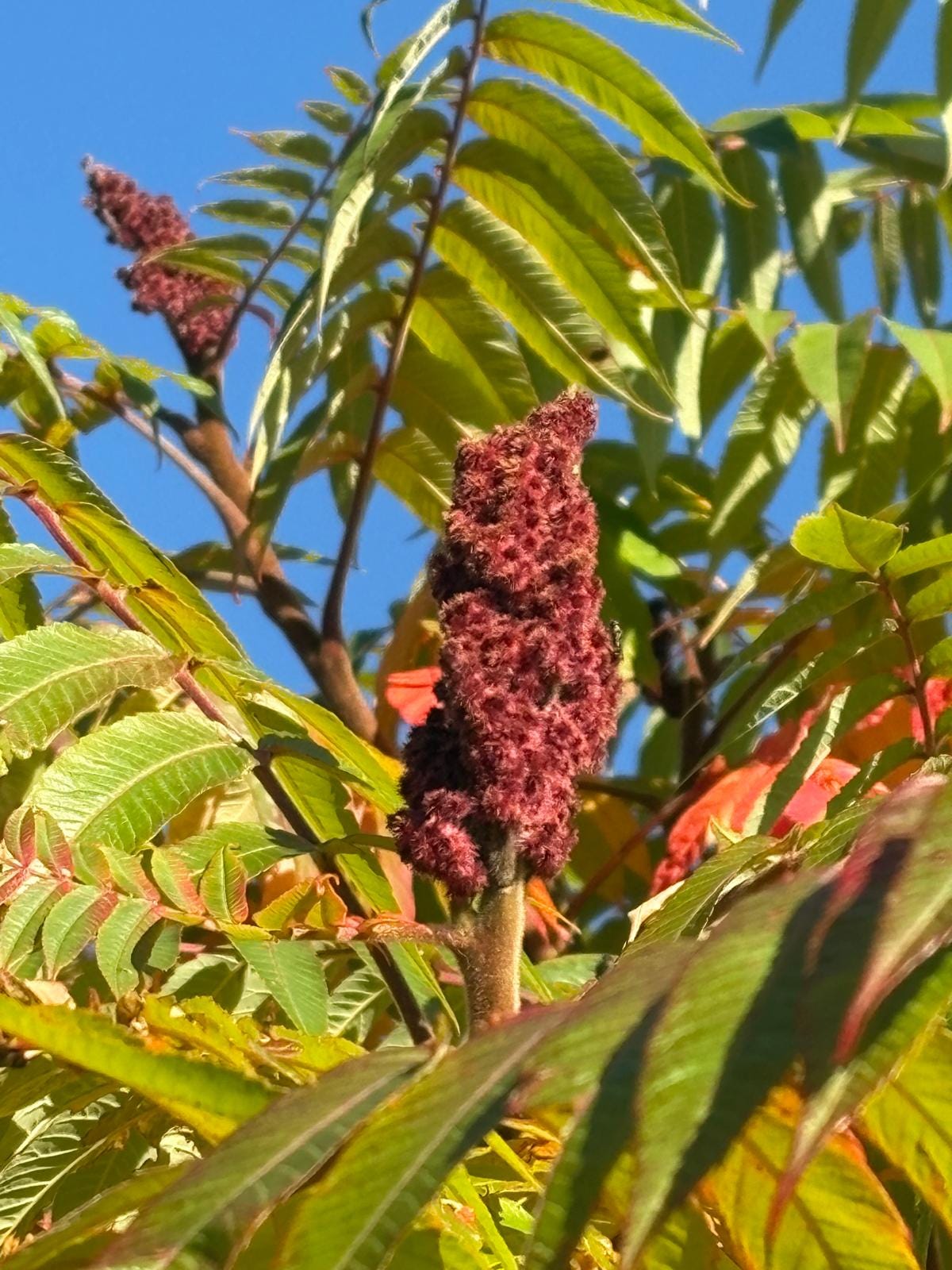
For over a century, the staghorn sumac (Rhus typhina) has grown quietly in Ireland. It is not native, but it is not new. It as with many of the floral and fauna in Ireland, an immigrant that has yet to get its Irish passport.
Perhaps you need to be here as long as the potato to be accepted.
Introduced to Victorian gardens and estates in the 19th century, the plant was prized for its ornamental qualities: the fiery foliage in autumn, the strange velvety cones of red drupes, its ability to naturalise easily in hedgerows and parkland.1 It was never planted for food. Like elderflower once was, like sea buckthorn more recently, sumac stood in the background, decorative, overlooked, unharvested.
Victorian Introductions
The Victorians had a particular zeal for importing exotic plants. Botanical gardens, country estates, and even suburban plots became staging grounds for what was essentially a global trade in ornament, colonial gardens that could position the viewer elsewhere in the world.2 Rhododendrons, Gunnera tinctoria, or giant rhubarb, Japanese knotweed, monkey puzzle trees, and sumac all arrived in this period, sometimes flourishing, sometimes failing, sometimes becoming invasive.
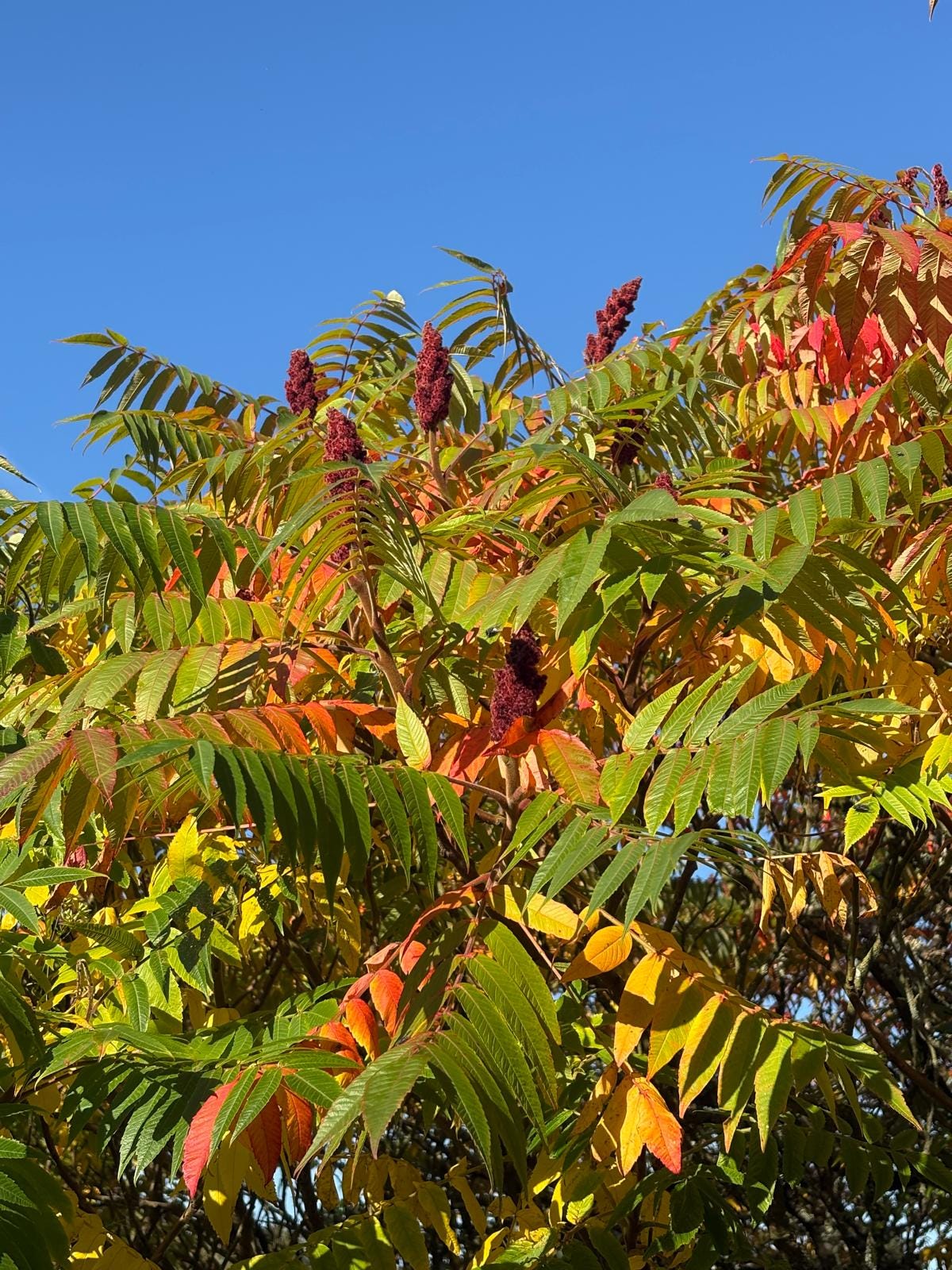
Sumac never reached the notoriety of rhododendron, giant rhubarb or Japanese knotweed. Instead, it lingered as a curious tree with architectural branches and startling fruit. In parts of Ireland, it naturalised at the margins, tolerated but rarely celebrated. Its potential as food remained hidden, even though the knowledge was always there, preserved in other culinary traditions.3
A Tradition of Sourness
Irish food has always required sourness. Our climate does not naturally provide lemons, limes, or the citrus fruits that structure acidity in southern cuisines. Instead, we had to develop our own vocabulary of sour in Aniar. As well as making our own flavoured vinegars and ferments, we use many plants, wild and cultivated. As Darina Allen observes, sorrel, with its sharp, oxalic tang, has long been used in soups and sauces in Ireland.4 Gooseberries offer tartness in spring, most famously paired with mackerel in Irish food.5 We choose to salt the gooseberries and keep them for the winter, serving them with fish and shellfish. Crab apples also provided the Irish palate with astringency and pectin, while rowan berries added bitterness alongside their sour edge.6
Buttermilk and whey have played vital roles in both cooking and drinking in ancient Ireland and remain vital for our vocabulary of sour in the restaurant.7 Oysters with buttermilk was one of the first steps towards breaking away from lemons.
Sumac, with its vivid, citric brightness, enters naturally into this tradition of sourness. Though not historically part of our kitchens, it occupies the same flavour space. It is not a replacement, but another voice in the choir of sourness, another way of expressing acidity in Irish food and food in Ireland.
It shows that Irish food is not static but rather continually evolving.
Global Meets Local
What does it mean, then, to cook with Irish-grown sumac? It is tempting to describe it as a “foreign” spice grown here, but this overlooks the reality that food culture is never fixed. Plants and people have always moved. Potatoes, tomatoes, Japanese rosehip, rhubarb, and chillies were all migrants once, unfamiliar intruders that slowly became inseparable from Irish life.
Even wild plants, such as three-cornered leek and nasturtiums, now part of Irish food, are not native and came to Ireland over the years by way of the migration of people.
When we use sumac grown in Ireland, we begin to write a new story for it, one that belongs here as much as anywhere else. The fact that the plant has taken root in Irish soil allows us to see it as part of our evolving terroir. It shifts from being an exotic garnish, associated with the Middle East to an ingredient that reflects both the past and present of this island: Victorian garden heritage on one hand, contemporary culinary innovation on the other.
At Aniar
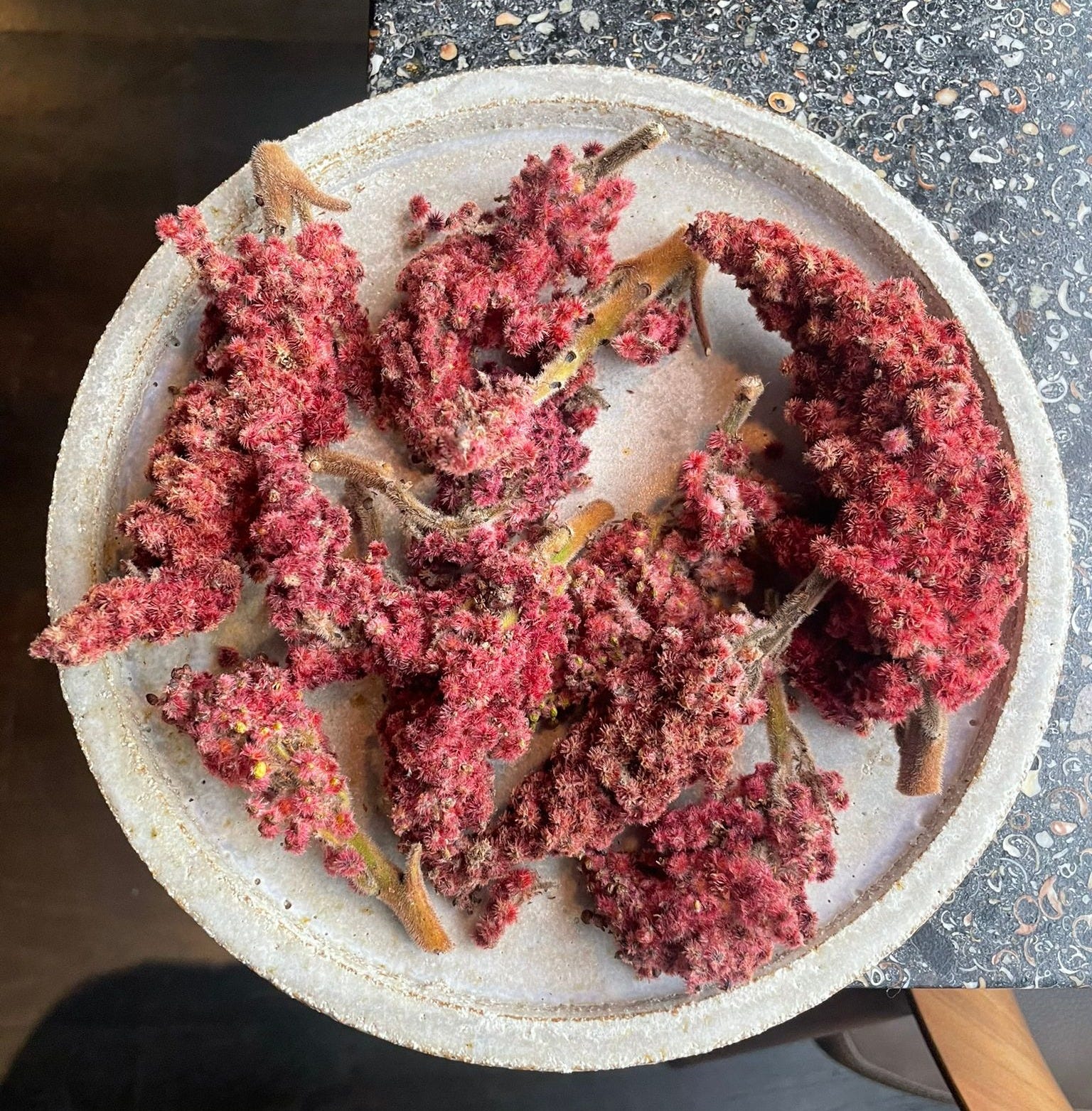
In Aniar, our approach has always been to work with what grows around us, to see terroir not as a static category but as something dynamic, responsive, alive. When we use Irish sumac, we do so in dialogue with traditional sour elements. A sumac vinegar sits alongside sorrel vinegar. A sumac jelly could be paired with lamb or duck in the same way one might use rowan berries or crab apples. A sumac infusion is fermented into a pinkish tonic, part of our ongoing work with wild drinks for our non-alcoholic pairing.
We also use it directly in place of citrus. An oyster from Kelly’s, dressed not with lemon but with Irish sumac and seaweed vinegar, becomes a small act of translation: a Middle Eastern spice speaking in an Irish accent.
A piece of mackerel, cured with sumac salt, echoes the old gooseberry sauce of the 18th century, while finding its own voice in the 21st century.
A granita of sumac sugar, served with rowan berry compote, creates a conversation between two sour fruits (one native, one introduced) both equally red, sharp, and startling.
These are just a few possibilities.
Toward an Irish Sumac
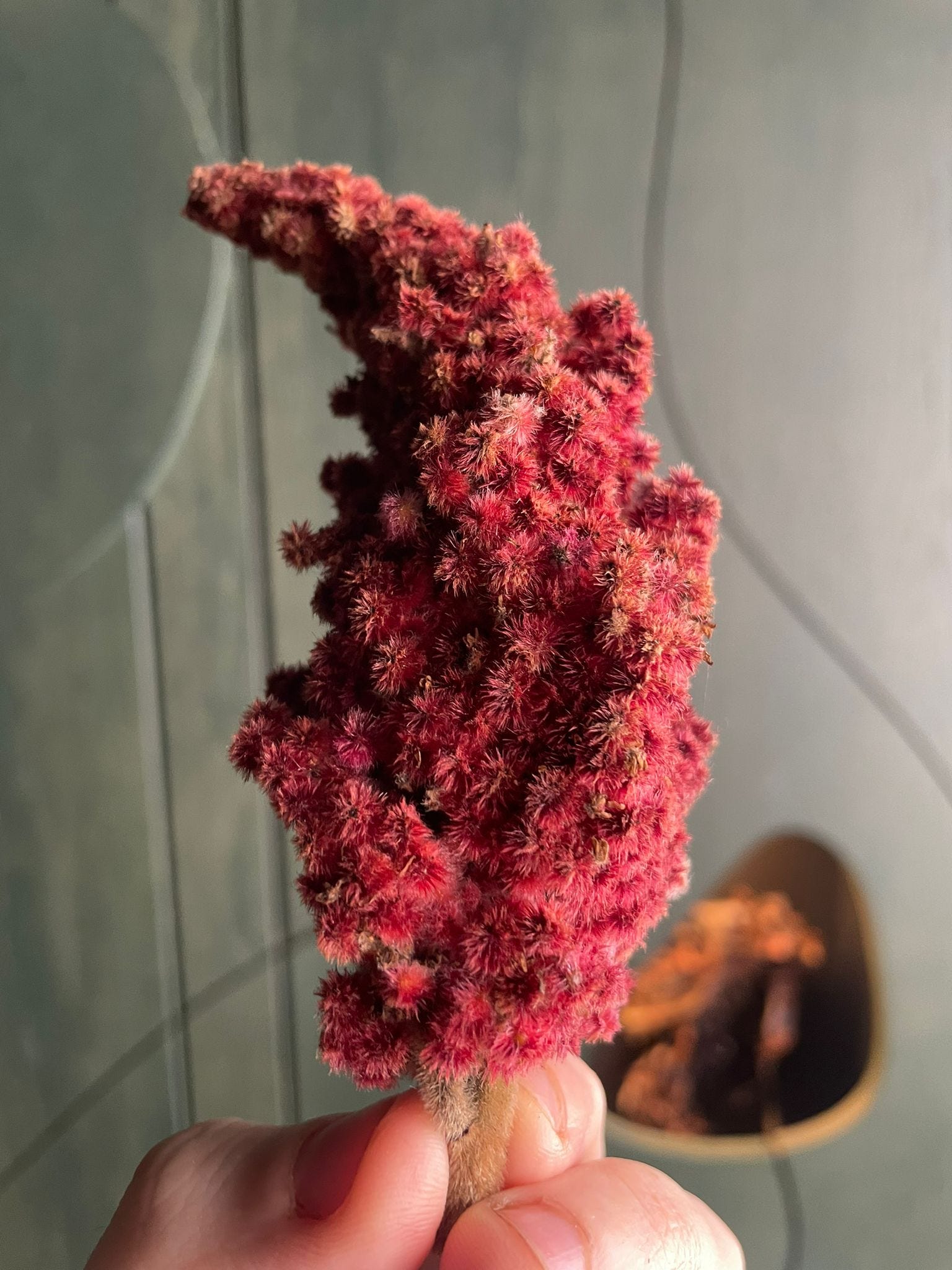
None of this is about authenticity in the narrow sense. It is not about claiming that sumac has always been Irish or about erasing its global origins. Rather, it is about recognising that foodways are porous.
Plants migrate, cultures overlap, and kitchens absorb what grows in their soil. The question is not whether sumac is Irish, but whether we are willing to make it so.
In that sense, Irish sumac is a reminder of what food culture really is: not a fixed heritage, but a continual process of renewal. Just as potatoes once travelled from the Andes to become our national staple, so too sumac, once merely ornamental, may now enter our flavour memory. If we choose to harvest it, cook with it, and taste it, it becomes ours.
It becomes part of our terroir: from food in Ireland to Irish food. It is our sour.
For me, Irish-grown sumac is not an imported spice but a rediscovered plant. It is part of our landscape, part of our terroir, part of our future. To use it is to acknowledge that Irish food, like Ireland itself, is always in motion, shaped by what takes root, by what survives, and by what we are bold enough to taste.
Foodways are porous.
Plants migrate.
People migrate.
Terroir is historical as well as migratory.
What we call “our” food is always shifting, always in motion. The potato teaches us this: what begins as foreign may, in time, become the heart of a culture. To use Irish sumac is to imagine that possibility again.
“Go mbeirimid beo ar an am seo arís” (That we may live to see this time again).
Someday, sumac may be as Irish as the potato.
All the best,
Jp.
29th September, 2025.
Webb, D.A., Parnell, J., & Doogue, D. An Irish Flora. Dublin: Dundalgan Press, 1996.
Nelson, E. Charles. A Heritage of Beauty: The Garden Plants of Ireland. Dublin: Irish Garden Plant Society, 2000.
Davidson, Alan. The Oxford Companion to Food. Oxford: Oxford University Press, 2014 (entry: “Sumac”).
Allen, Darina. Irish Traditional Cooking. Cork: Gill & Macmillan, 2004
Redington, Josephine. Old Irish Recipes. Dublin: Gill, 1963.
Flinn, D. Wild Food: A Complete Guide for Foragers. London: Collins, 1983.
Sexton, Regina. A Little History of Irish Food. Dublin: Gill & Macmillan, 1998.
All very interesting, JP. I buy sumac from Mr Bell. He's on line now, as well as in Cork's English Market.
Have always been partial to a Sumac tree, Jp. Had a lovely one in the garden of my former home in Clondalkin. But never knew that it is a food source 😮. Amazing!