
On New Potatoes
An Irish food calendar

Go mbeirimid beo ar an am seo arís” (That we may be alive at this time again).
There are few foods in Ireland as humble as the new potato, and yet few arrive with such quiet ceremony. They don’t arrive not a feast day or government proclamation, but with the first real turn of summer: late May if the year is kind, but by June and July the taste is there to be savoured. The skin is loose and thin, and it comes away under your thumb, something that fascinated me as a child. The potato itself is small, waxy, almost sweet, and needs very little from the cook: water, salt, and good butter.
To eat them is to taste the beginning of the Irish summer.
In the old agricultural year, the potato was not merely a vegetable but a measure of time, and hence, survival. In the Dúchas Schools’ Collection, the work of potato growing is described in intimate detail: the cutting of seed potatoes, the care taken that each piece had an “eye”, the opening and closing of drills, the use of farmyard manure, the later moulding of the young plants.
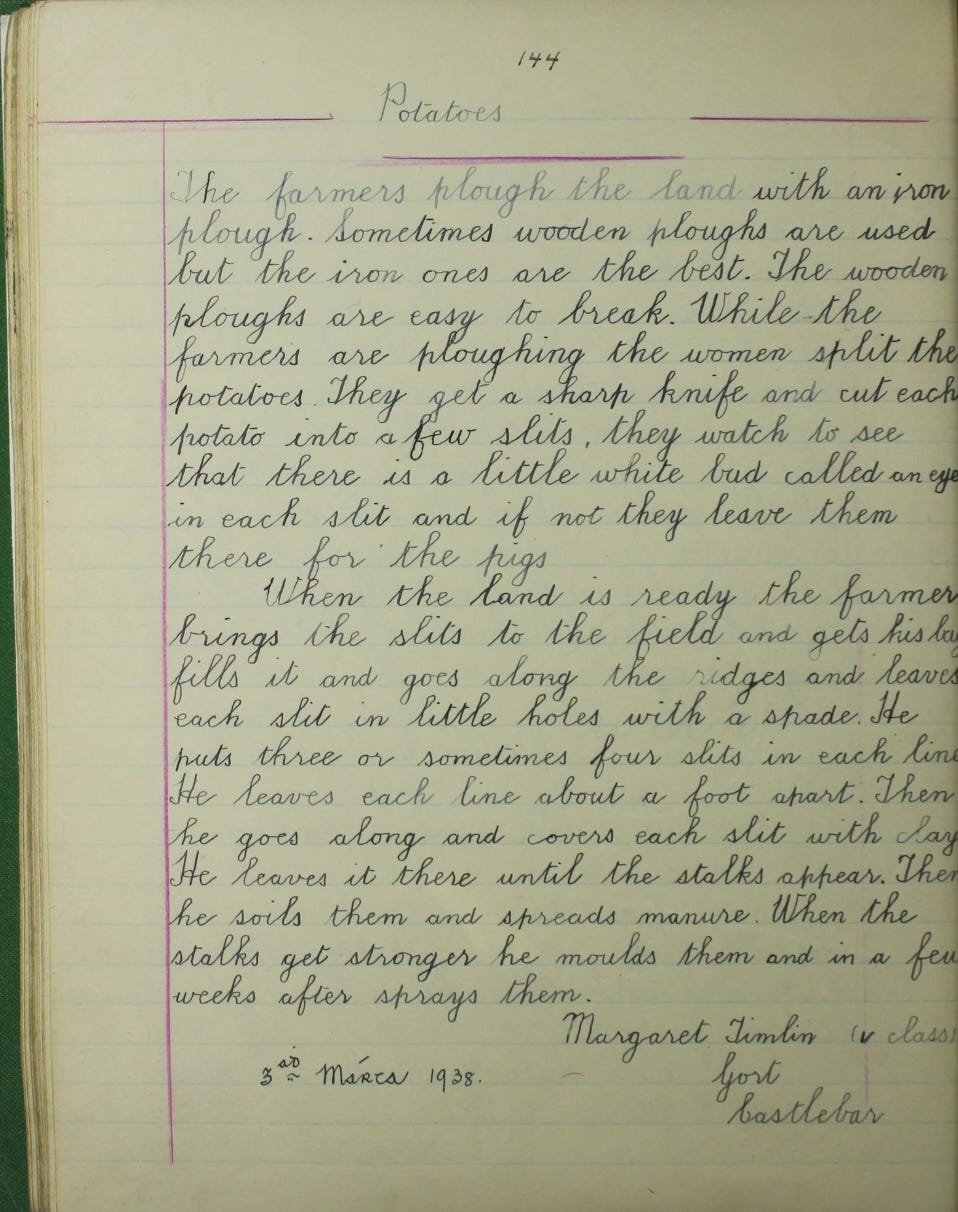
On 3rd March, Margaret Timlin from Class V in Gort, Castlebar (Co. Mayo) wrote:
The farmers plough the land with an iron plough. Sometimes wooden ploughs are used but the iron ones are the best. The wooden ploughs are easy to break. While the farmers are ploughing the women split the potatoes. They get a sharp knife and cut each potato into a few slits; they watch to see that there is a little white bud called an eye in each slit and if not they leave them there for the pigs.
When the land is ready the farmer brings the slits to the field and gets his bag fills it and goes along the ridges and leaves each slit in little holes with a spade. He puts three or sometimes four slits in each line. He leaves each line about a foot apart. Then he goes along and covers each slit with clay. He leaves it there until the stalks appear. Then he soils them and spreads manure. When the stalks get stronger he moulds them and in a few weeks after he sprays them
(The Schools’ Collection, Volume 0094, Page 144).
This account is deeply practical, rather than romantic and serves as a reminder to us before the potato became nostalgic to our generation who rarely encounter a potato field. The potato was hard work and in it contained knowledge both of the year and past generations.
In his The Year in Ireland (1972), Kevin Danaher places Irish food customs within the broader rhythm of the year, between feast days, harvest, and fairs. The new potato belongs to this rhythm. It is not quite harvest in the full Lúnasa sense, as we shall see, but it is a first reward, a sign that the hungry gap of has been crossed. Before the maincrop, before the storing potatoes of autumn and winter, this is this first taste that the earth gives back (Mahon, 1991: 135). Early planting in February or March produced a May harvest, while planting in April was for a June or July harvest.
The varieties carry their own memories.
Home Guard, one of the classic first earlies, has that wartime name and early promise. British Queen, flourier and deeply loved in Ireland, has long been associated with summer eating, their thin skins splitting open under butter and salt. Orla and Colleen are more recent Irish varieties, clean, reliable, suited to the modern grower, such as Beechlawn farm in Ballinasloe, Co. Galwya.
Queens remain, for many, the taste of July in Ireland.
Charlotte, though not Irish in origin, has become familiar on Irish tables: waxy, elegant, good warm with butter or cold in a salad. This is the variety we often serve in June in Aniar, cooking them submerged in butter until the break open.
Each variety has its own texture, but the idea is the same. It is the potato before it has hardened in storage, before it has become food of the winter.
For many of us of a certain generation, new potatoes also belong to the green and verdant roadside, to a world before motorways. They sit in my memory beside summer strawberries: punnets and paper bags, hand-painted signs and a white trestle table, the smell of warm tarmac under the summer sun. From Wexford to Galway, in pockets all over the country, the road itself became, and still is in some cases, a little seasonal market. You knew summer had arrived when strawberries and new potatoes appeared together on the side of the road.
Memory and desire mixes together as the young lady passed you both bags.
One stained the fingers red while the other often left clay under the nails.
Both were temporary and both had to be eaten quickly.
New potatoes gave substance to domesticity, the promise of real dinner of ritual. Boiled in their skins, rolled in a little butter (or Flora in my grandma’s house), they needed no culinary ambition, or forsake the best. They were best eaten with steam rising from the bowl.
They paired beautifully with tinned mackerel, with roast lamb or ham on a Sunday, with chopped scallions straight from the garden scattered through the butter, or cold at teatime with a boiled egg and some salad cream. Growing up in the early 1980s, they were the perfect expression of Irish summer. They were our food culture before we even had words to define it as such.
The new potato is not the great tragic potato of Irish history, that is the lumper potato, though its shadow is always present.
It is a lighter thing.
The new potato resides before storage and scarcity, before the memory of the famine darkens our vision of what the potato means to Irish food. The new potato reminds us that Irish food culture is not only about famine, loss and hunger.
It is just as much about anticipation and pleasure.
It is a bag of potatoes bought from the side of the road. It is a saucepan on the stove. It is butter melting over fluffed skins. It is salt and steam on an evening in June when time seems to stand still and all is good with Irish food.
Yours in Irish food,
Jp.
17th June, 2026.
Queens will be lifted in the first week of July on my small plot. I’m already dreaming of ‘balls of flour’.
I am looking forward to buying those new potatoes on the Kerry highways and byways. Butter, salt and parsley. Scrumptious 😋 😍