
From Oxymoron to Identity
The evolution of Irish Cuisine

Somewhere around the turn of the 21st century, the phase “Irish cuisine is an oxymoron” began to be bandied about. Undoubtedly influenced by the ways in which French cuisine projected itself on a global level, it marked a moment of historical prejudice and cultural amnesia related to Ireland food culture.
There may have been food in Ireland but surely there was no cuisine.
In his article “Recognizing food as part of Ireland’s intangible cultural heritage” (2018) the chef and food historian Máirtín Mac Con Iomaire mentions: “Irish cuisine has been deemed by former Irish Times columnist Kevin Myers to be an oxymoron” in his An Irishman’s Diary (7 February 2002). However, the phrase and the attitude pre-existed Myers.
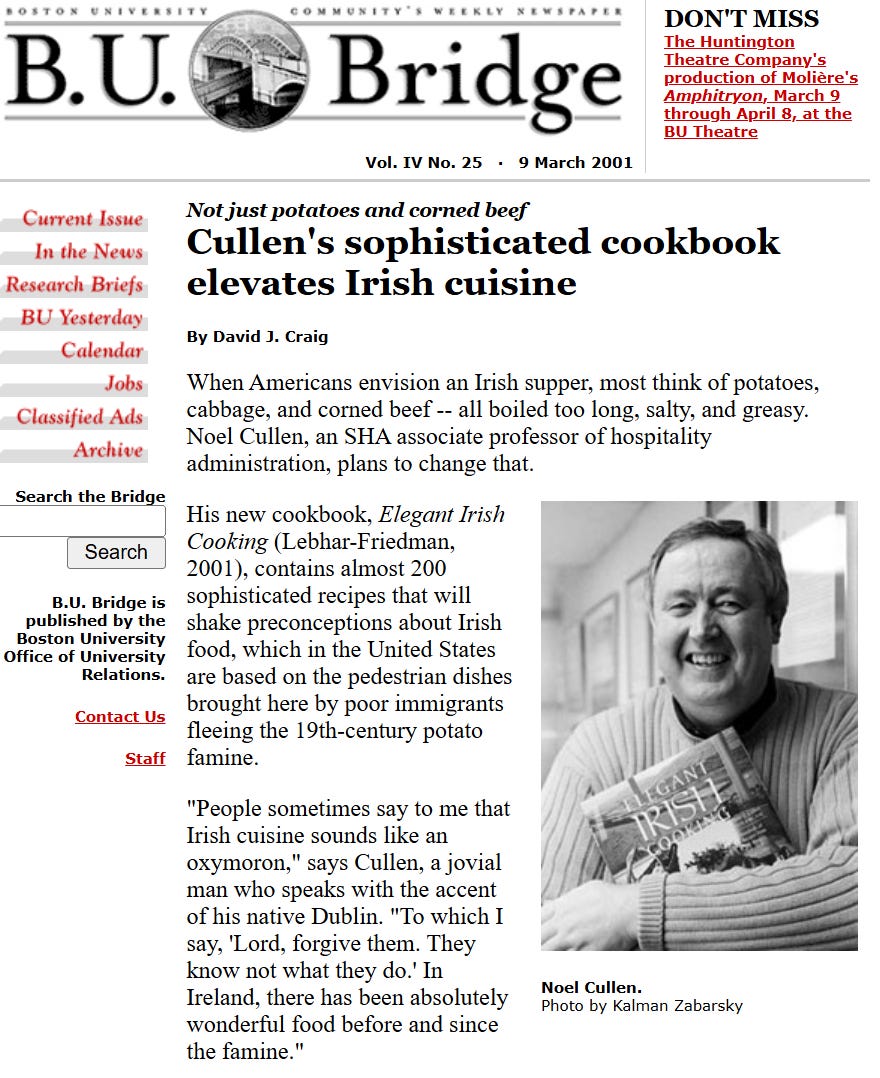
In the B.U. Bridge (9th March, 2001), a profile of chef Noel Cullen quotes him saying, “People sometimes say to me that Irish cuisine sounds like an oxymoron […] Lord forgive them. They know not what they do”. Indeed, it was a commonplace for many American critics to deride Ireland in relation to its food culture.
Yet, the origin of the phrase is less important that its associated meanings, its significance that we have never had a food culture on the island of Ireland.
The story of Ireland’s colonial and economic history and its effect on our food culture is a well-known story, told so often that it has become the only truth about Irish food. The island of Ireland endured centuries of colonisation, land dispossession, and poverty. For much of the 18th–20th centuries, most of the population had little access to varied foodstuffs. The Famine, An Gorta Mór (1845–49) cemented the association of Irish food with subsistence, scarcity, and monotony rather than refinement or creativity.
Unlike France or Italy, who were building their sense of food identity during this time, Ireland did not project a codified haute cuisine tradition or regional cooking, nor was it able to due to colonialisation. Cooking was domestic, rural, and based on what was available. Dishes like stew, soda bread, and potatoes were seen abroad as peasant food rather than culinary achievements.
The Anglo-Irish aligned themselves with the European mainland, so a vacuum in our food culture was created. The Irish table became divided. On the one hand there was Ascendancy cuisine (French-inspired aristocratic fare). On the other there was peasant subsistence (oats, potatoes, dairy)
Food became a tool of domination — the coloniser’s dinner table was a stage for empire.
However, prior to the 1800s, and indeed, before colonialisation, there existed a distinct Gaelic food culture. Ireland had a sophisticated native food system long before colonial disruption: dairy, oats, barley, fish, seaweed, honey, wild herbs, and seasonal feasting. The Brehon laws mention honey, butter, and ale; monasteries cultivated orchards and brewed beer, imported fruit and wine from the European mainland. In truth Irish foodways were deeply regional, more about season and hospitality than a ‘formal’ cuisine.
There was a thriving wild food scene, and this connected us directly to the land.
The Famine and its aftermath (1840s–1900) codified the symbol of Irish food as one of survival and shame. The Famine devastated Irish food identity. The potato became solely associated with Ireland as if it were the only ingredient in Ireland.
Food became politicised.
Abundance was exported while the poor native population starved. The collapse of native farming traditions led to a sense of culinary amnesia in rural areas. British travel writers dismissed Irish food as primitive and unsophisticated, unaware that it was their colonial project that had produced the current food system on the island.
This loss continued with the growth of the independence movement and the foundation of the Irish State in 1922. As Mac Con Iomaire observes:
“During the Celtic revival in the late 19th century, nobody thought of food culture as an element in nation building. Literature, folklore, music and drink were considered, but food remained outside that list of chosen ‘national’ categories. The relatively modern concept of ‘national’ food, therefore, presents certain difficulties of definition in an Irish context, the island having gained independence only in 1922”.
A massive amount of emigration meant Irish people encountered richer cuisines abroad, reinforcing the idea that Ireland lacked one of its own at home. Ironically, many of these cuisines would have been experienced second hand, such as Italian food in America and French food in England (as well as Ireland).
Cultural amnesia of the culinary kind is not confined to the Irish. Many countries in the 20th century struggled to assert a national food culture. One could argue the reason for this is that cuisine is associated with power as opposed to authenticity, thus only those in power could assert themselves.
In her book Cuisine and Empire: Cooking in World History (2013), Rachel Laudan observes how cuisines are a product of conquest, hierarchy, and exchange, not authenticity or nation states.
“Cuisines are political creations — systems of cooking and eating that emerge from empires, sustained by ideology, and spread by conquest.”
This is a crucial point regarding the formation of Irish cuisine and its regulation in the 19th and 20th century. As Ireland was under the imperial sign of Britain, it was virtually impossible for its to assert itself and its post-colonial position was not much better.
“The spread of empires meant the spread of culinary ideologies — of what it meant to eat well, properly, and with virtue.”
The major culinary revolutions in world history, according to Laudan are tied to imperial or religious worldviews. As empires rise and fall, they spread not only armies and languages but also culinary systems such as methods, values, and ingredients. Thus, all cuisines are subject to migratory patterns that cross national borders.
All cuisines are porous, full of holes, which allow them to be adapted and modified at a future date. Thus, there is no ultimate originary point of a cuisine but rather a continually evolving one.
One could argue that any national cuisine is an oxymoron.
For Irish food studies and its foodways, Laudan’s framework is extremely useful. Ireland’s colonial food history of dispossession, export economies, and famine fits squarely within her cuisine and empire model. Her argument helps explain why Irish cuisine was long subsumed under British imperial cuisine, and why much modern Irish cooking, or new Irish cuisine, represents a postcolonial reclamation of taste and terroir, as well as our attitude to storytelling and sustainability.
Irish cuisine involves a reassessment of its pre-colonial past. Not out of nostalgia, but rather as a reclamation. You could say that the Irish culinary revival is a late decolonisation of the palate, an attempt to create a national cuisine after centuries of culinary empire.
This is to say that this journey is not without its misgivings.
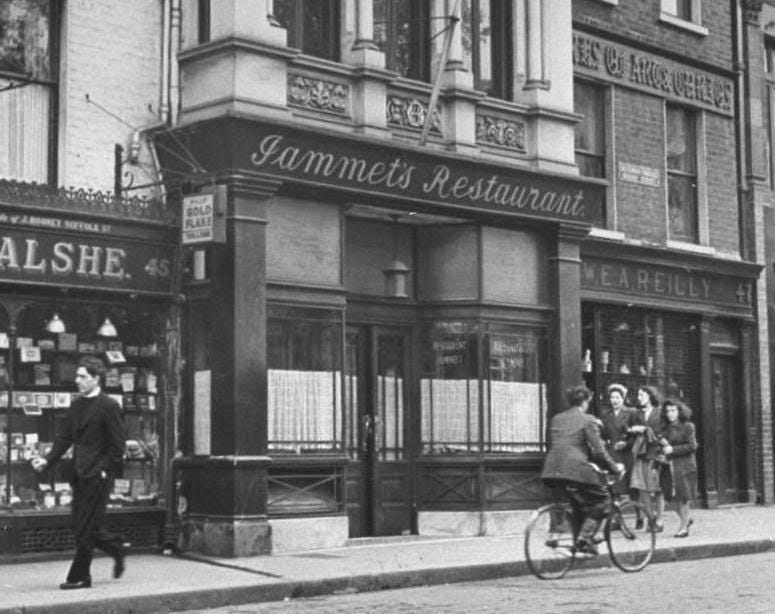
Through the mid-20th century, many Irish restaurants often had a poor reputation internationally: overcooked vegetables, bland meats, lack of seasoning. Travel writers and critics repeated the stereotype, laughing and joking about Irish food and cuisine. Yet, this is not to say that Dublin, or Ireland, did not have good restaurants. Just that the cuisine associated with them was not Irish, but French (for the most part). Jammet’s is a good example of world class food in Dublin during the mid-century.
Post-Independence Ireland pitched itself as a place of purity and penance. To a degree, the Catholic moral order of morality, and austerity became intertwined with the de-colonising state. If cuisine is a moral philosophy made edible, as Laudan argues, then the Irish Free State promoted modest domestic cooking: boiled meats, stews, soda bread to demonstrate the morally upright and thrifty character of the Irish people.
Food was tied to Catholic virtue, echoing Laudan’s “sacred cuisines” of restraint. However, industrial foods and British imports persisted, meaning little change in the national taste of the Irish people. The word ‘cuisine’ was a nasty piece of work associated with foreign decadence; thus, Irish cuisine sounded like an oxymoron, because the Irish were a humble, simple people, somehow beyond food culture.
The professionalisation of chef training and restaurant culture that Ireland blossomed in the late 20th century was directly influenced by nouvelle cuisine, French classical training, and returning emigrants. Journalists and columnists still recycled the “oxymoron” line because it was easy shorthand for Ireland’s supposedly poor food reputation.
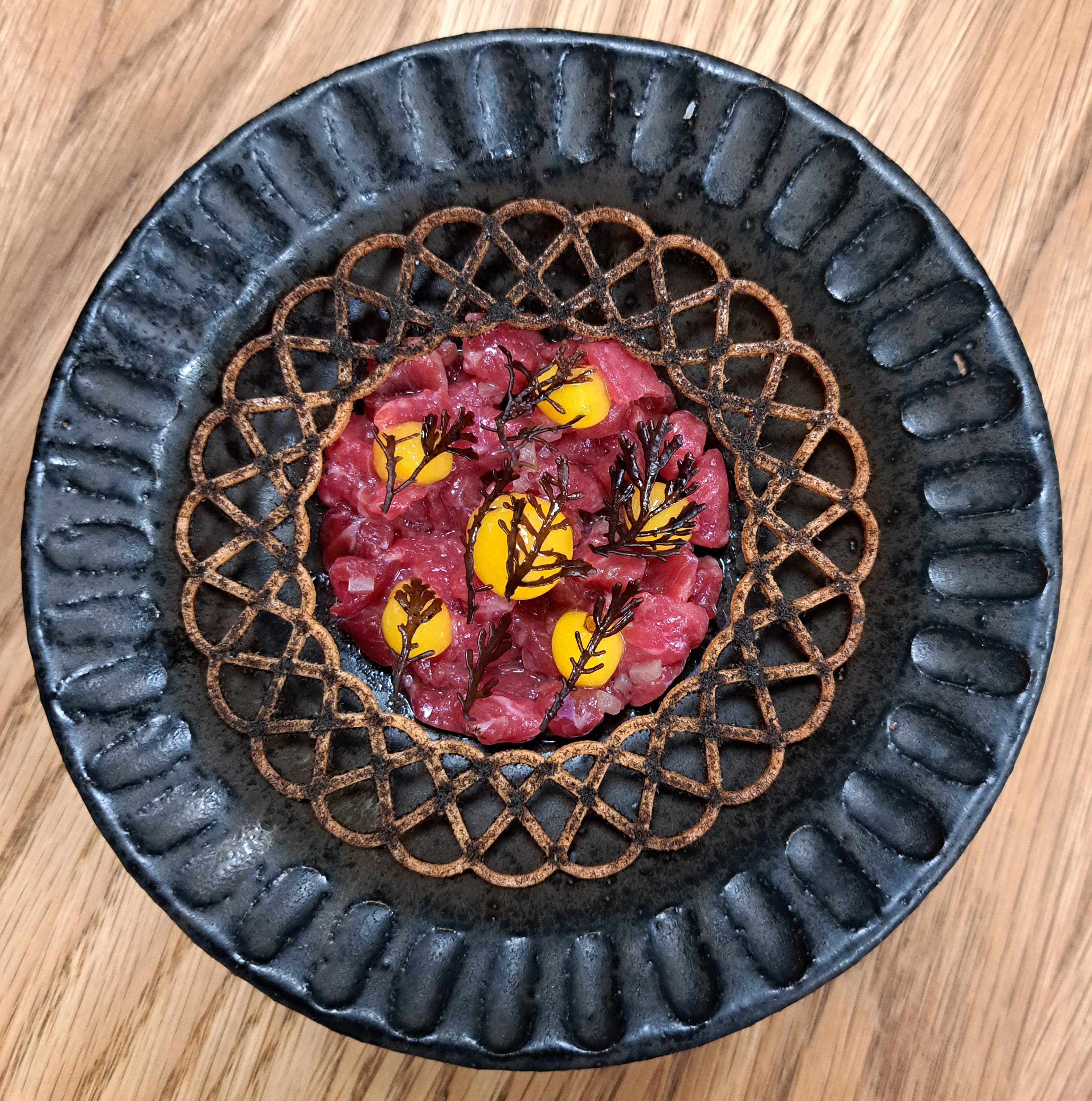
As I observed at the beginning, writers like Kevin Myers (2002) and US food critics used it as a kind of cultural joke, even while chefs like Myrtle Allen of Ballymaloe House were already proving the opposite since at least the 1960s. Indeed, Allen ran La Ferme Irlandaise in Paris from 1981 to 1985, an Irish restaurant in the gourmet capital of the world.
By the 2000s, Irish chefs were winning Michelin stars, and writers like Colman Andrews, whose book The Country Cooking of Ireland was published in 2009, helped dismantle the old cliché.
However, were does that lead us?
Do we now have an Irish cuisine?
Have we left the realm of the oxymoronic and entered the place of Irish imperial identity?
The truth is somewhere in-between.
In the 21st century, cuisine has become somewhat decentered. We have moved outward from France and towards other empires and nation states, from Aztec empires to Mughal India. However, this is still not the case in terms of all food culture and education in the wider public.
There are still food empires in our globalized world, cuisines of convenience, technology, and global capitalism
Authenticity still exists for most of us. We don’t want food to be political or have philosophical depth. We don’t want an Irish national cooking. We want to hide under a culinary cloak of nostalgia and amnesia. We don’t want Irish food to be world class. We want to sit behind our other imperial neighbours and not rock the boat too much.
Therefore, for many, Irish cuisine is still an oxymoron.
However, in contemporary Ireland, there is another kitchen: a kitchen as a site of post-colonial self-definition. It is one of storytelling and sustainability, of pushing food into the space of ethical and ecological considerations. This culinary revolution of Irish cuisine connects with pre-colonial values of locality, reciprocity, and the moral landscape, but through a contemporary, artistic lens.
It is the cooking of Aniar (Galway), of OX (Belfast), and other Irish restaurants that seek to redefine what Irish cuisine means in an era of global food.
Irish cuisine is no longer defined by empire but by its resistance to it.
The idea that Irish cuisine is an oxymoron belongs to a colonial worldview in which cuisine itself is defined by power by who could afford to codify their taste.
It would be naive of me to say that this attitude no longer exists. Where there is power there is cuisine, and where there is cuisine there is empire.
And not always the good kind.
Saying that, one could argue that Irish cuisine has re-entered, or simply entered, history. It is not, or is no longer, an imitation of France or Italy, but a form of moral thought grounded in ecology, memory, storytelling, and sustainability. In Laudan’s terms, Ireland has moved from being the object of empire to being a subject of cuisine, one capable of articulating its own moral order through food.
How far we can go is up to us all.
“To eat is to embody a world order.”
Best, Jp.
6th October, 2025.
What a brilliant article Thanks JP I still cook from my copy of Theodora Fitzgibbon’s A Taste of Ireland. By the way her encyclopaedia Food of the Western World is an excellent book.