
Boucicault after Beckett
Farce, Failure and Food.

After Beckett, we cannot watch Boucicault in quite the same way.
The disguises, miraculous escapes, threatened executions, hidden identities and last-minute rescues of The Shaughraun (1874) may appear to belong to a theatrical world far removed from the bare road of Waiting for Godot (1953/55). Boucicault fills the stage with every conceivable incident. Beckett seems to remove incidents altogether. One playwright creates a world of sensation and resolution in the turning arch of 19th century theatre, while the other leaves two men beside a tree, waiting for something that never happens.
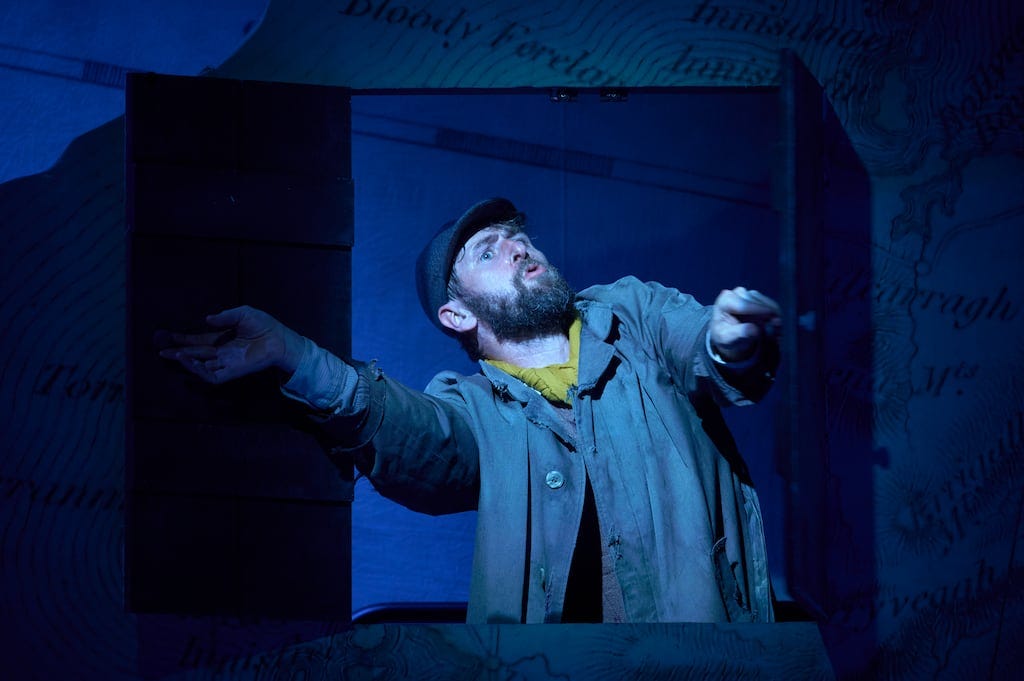
Beckett grew up in a Dublin theatrical culture in which Boucicault’s Irish melodramas, particularly The Shaughraun, The Colleen Bawn (1860) and Arrah-na-Pogue (1864), remained familiar popular works. They had been repeatedly revived in Dublin around the turn of the century and formed part of the theatrical inheritance against which the Abbey and the Literary Revival defined themselves, as Christoper Murray observes in his essay “Echoes down the Corridor: The Abbey Theatre, 1904-2004” (2007).
While we do not know if Beckett actually witnessed a Boucicault production in the Abbey, we know he knew and admired Yeats’s painting In Memory of Boucicault and Bianconi (1937), which depicts a travelling theatrical company apparently performing a scene from Boucicault’s The Shaughraun. In his book Samuel Beckett and the Visual Arts (Cambridge University Press, 2018) Conor Carville notes that this was the painting that initially prompted Beckett to connect Yeats with Watteau. Though this does not prove that Beckett had carefully studied Boucicault’s complete dramatic works, it does show that Boucicault and The Shaughraun belonged to the theatrical and visual vocabulary Beckett understood in terms of his own developing aesthetic.
Beckett certainly knew who Boucicault was and understood the theatrical world represented by his Irish melodramas at home and abroad. However, a sustained or consciously acknowledged Boucicault influence on Beckett has never been firmly documented, despite papers, books and PhD’s tracing their trajectory for Ireland’s theatrical history.1
A more interesting argument may be less that Beckett imitated or was influenced by Boucicault than that he emptied out the machinery of melodrama for this postwar purpose. Boucicault’s plays give us threatened bodies and miraculous escapes, villains and revelations, disguises and last-minute rescues. Beckett’s plays retain the waiting, the delayed entrances, the silly repeated routines, the physical jeopardy and the expectation of rescue. But he removes the rescue. In that sense, Waiting for Godot could be read as an Irish melodrama after the plot, spectacle and providential conclusion have disappeared. The duality of the comic Irish double act appears for both, but in very different ways. Beckett infects Boucicault so that we can no longer see his melodrama as some quaint Victorian form.
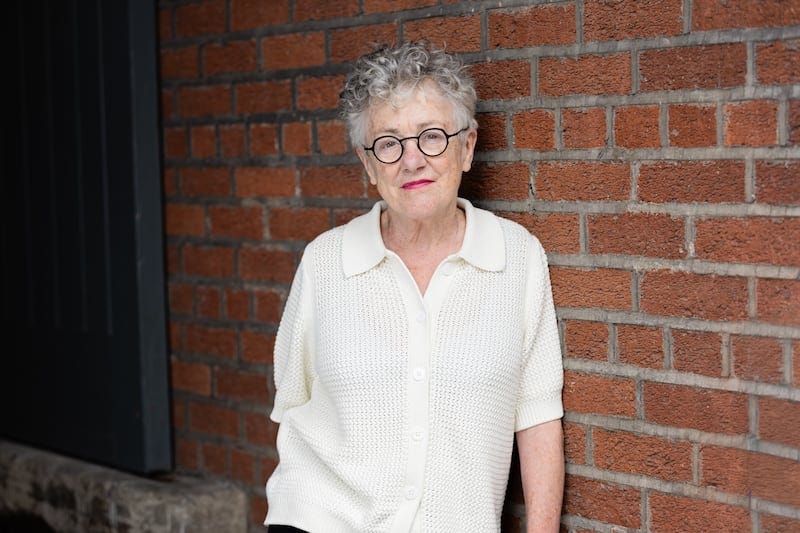
Vivian Mercier’s account of The Irish Comic Tradition (1962) provides another way of understanding the continuity between the two playwrights, both backwards and forwards. Mercier argues that Irish comedy is marked not simply by verbal wit or genial humour, but by fantasy, grotesquerie, the macabre and an unusual intimacy between laughter and death. Comedy does not necessarily overcome suffering.
It inhabits it and often makes it bearable.
Bodies are beaten, starved, dismembered, resurrected or made ridiculous, while language continues to turn catastrophe into performance. Beckett, whom Mercier knew, regarded him as an inheritor of this older Gaelic tradition, radicalises rather than abandons its comic logic. His famous description of Waiting for Godot as a play in which “nothing happens, twice” identifies repetition itself as a source of comedy, but the repetition is inseparable from exhaustion, hunger and the anticipation of death (Mercier, 1977).
Boucicault and Beckett therefore occupy different regions of the same Irish comic imagination. In Boucicault, the threatened body escapes and the apparent corpse rises. In Beckett, the body fails repeatedly but is denied even the completion of death. The man falls, gets up, complains and begins the routine again.
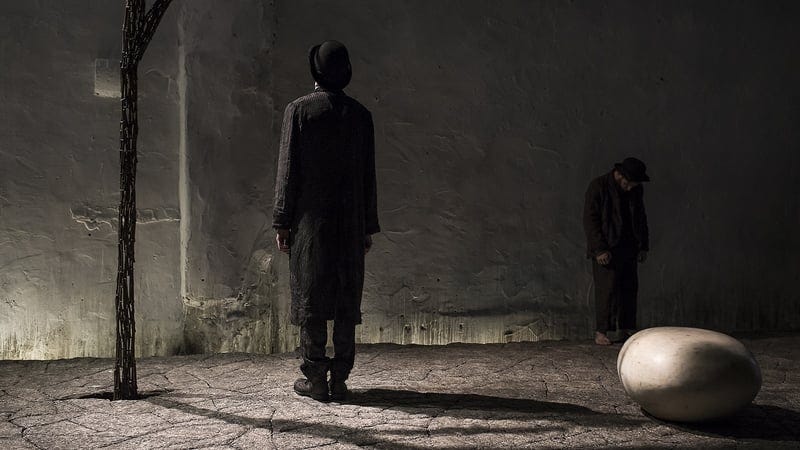
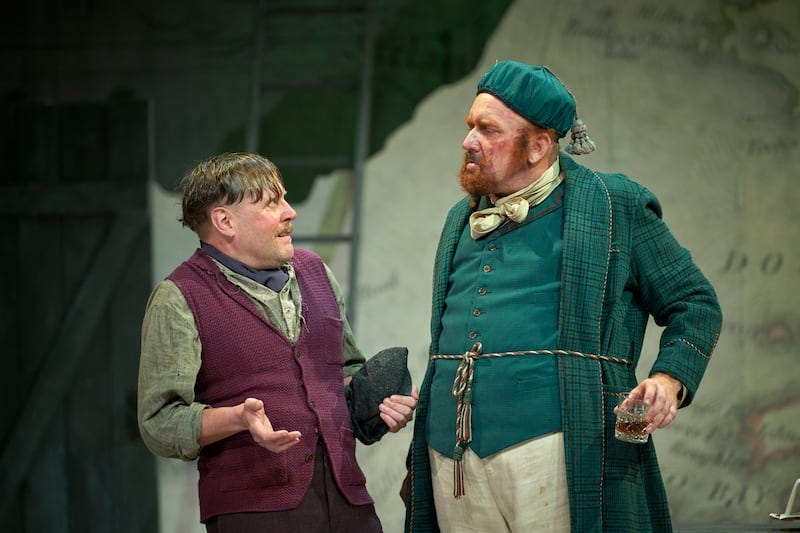
Druid’s productions of the two plays reveal this complicated relationship. Garry Hynes’s 2016 production of Waiting for Godot featured Aaron Monaghan as Estragon, Marty Rea as Vladimir and Rory Nolan as Pozzo. Ten years later, the same actors return in Druid’s 2026 production of The Shaughraun: Monaghan as Conn, Rea as Robert Ffolliott and Nolan as Corry Kinchela. Francis O’Connor designed both productions, while Nick Winston worked on movement for each. The repetition of actors and creative personnel encourages us to see Boucicault not simply as a Victorian predecessor whom Beckett rendered obsolete, but as part of a continuing Irish performance tradition. We are in the space of afters: Beckett after Boucicault as well as Boucicault after Beckett. Beckett exerts a kind of retroactive influence or anachronic thinking upon Boucicault. Once we have seen Waiting for Godot, certain gestures, doubles and structures in Boucicault become newly visible. In a Borgesian reversal of literary chronology, Beckett appears to create Boucicault as one of his precursors.
The casting choice produces a kind of theatrical memory.
When Monaghan, Rea and Nolan appear in The Shaughraun, the bodies that inhabited Beckett’s landscape are still present beneath Boucicault’s costumes. The audience may remember their proportions, rhythms and relationships: Monaghan’s compact physical comedy, Rea’s height and anxious attentiveness, Nolan’s capacity to fill the stage with dangerous authority. The actors do not play the same characters, but they occupy comparable theatrical functions. Boucicault’s figures begin to look like the ancestors, or perhaps future ghosts of Beckett’s plays. This is not about inheritance. It is about creative invention, an anachronic side step, that shows us that time travels in more than one direction.
Aaron Monaghan’s Conn is the clearest example. Conn is the shaughraun: the wanderer and trickster, poacher and fiddler. He is the unlikely hero who moves between the settled structures of the play. A vagabond, of sorts. He belongs everywhere and nowhere. He possesses no conventional authority, yet he repeatedly controls events through his speech and the physicality of his performance. Seen after Monaghan’s Estragon, Conn appears as another version of the Irish comic survivor in the tradition of Flann O’Brien and many others.
Like Conn, Estragon lives outside settled society. His possessions are uncertain. His body is vulnerable and his immediate concerns are physical. He is all about his boots, his hunger, his sleep, and of course, the beating he received during the night. Like Conn, he survives through comic routines and through his relationship with another man. Both characters possess the intelligence of the melodramatic body. They fall, recover, improvise and turn suffering into performance.
But Conn inhabits a world in which comic ingenuity still works. He can intervene in history. His tricks have consequences. He can rescue Robert, defeat Kinchela, reunite lovers and help restore the community. Estragon retains the gestures of the trickster but has lost the trickster’s power. His routines fill time rather than transform the time around him. He can play at leaving, hanging himself or assuming another identity, but he cannot alter the structure in which he is trapped.
Estragon might therefore be understood as Conn after the possibility of rescue has disappeared. We can imagine Conn leaving the stage and living his life. There is no hope for Beckett’s Estragon. He waits, jokes, but nothing ever happens.
The Feast That Never Comes
The food of Waiting for Godot belongs to the same process of theatrical reduction. Boucicault’s drama moves towards the restoration of household, property, marriage and community. These are the structures within which eating might once again become communal and hopeful for a living Irish community. Beckett removes the household (perhaps it was wiped out in the war) and leaves only portable scraps: a carrot, a turnip, a radish, a piece of chicken and the bones that remain only after another man has eaten.
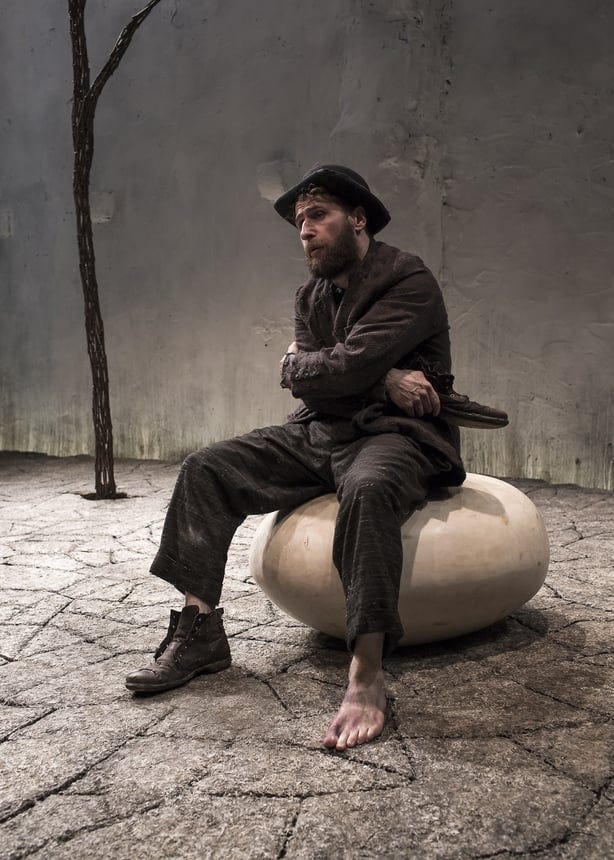
Estragon’s hunger is immediate and bodily. He does not wait only for Godot. He waits for relief, from his boots and beatings, exhaustion and his appetite that is never fulfilled. Vladimir’s vegetables offer momentary comfort. They never constitute a meal. There is no dinner time in Beckett. They are drawn from his pocket one at a time, as though hospitality itself has contracted into the private distribution of dwindling provisions in a landscape of famine and failure. Even the distinction between carrot and turnip matters because so little else changes. Taste becomes one of the few remaining forms of event in relation to food.
We may laugh, but this is not farce.
It is the failure of a food system unfolding in the play. As Thierry Dubost observes in his recent paper “A Sisyphean Carrot in Waiting for Godot” (2026) presented at the Dublin Gastronomy Symposium:
Estragon wages a losing battle against hunger, an attitude that possibly echoed the suffering of civilians during World War II or that may have resonated with the famines that had plagued Beckett’s native country in the nineteenth century (3).
Pozzo’s meal makes the social structure of food more explicit. Lucky carries the basket, Pozzo eats the chicken, and Estragon asks for the discarded bones. The meal is divided into labour, consumption and waste. Each character occupies a different position within that economy. Pozzo’s authority is not abstract: it is visible in his possession of food and in his freedom to eat before hungry spectators. Lucky, who carries the provisions, receives nothing.
Estragon may have only what the master has finished with. His food is a failure of commensality, the social act of eating together.
Read beside The Shaughraun, the scene suggests what Beckett has removed from Irish melodrama. Boucicault’s plots seek to recover the house, the land, the lovers and the rightful social order. The conclusion promises a world in which the community can gather again. Beckett retains hunger but abolishes the feast that would traditionally follow restoration. Godot’s arrival might bring employment, shelter, salvation or simply supper; because he never arrives, these possibilities remain indistinguishable.
The difference between Conn and Estragon can therefore be expressed through food as well as action. Conn belongs to a theatrical world in which survival may lead back into society. Estragon eats because survival is all that remains. He lives in a work of afters and ends. Boucicault’s comic body escapes danger and returns to the community. Beckett’s comic body eats a carrot beside the road and waits for tomorrow.
Boucicault offers threatened abundance restored.
Beckett leaves hunger, leftovers and postponed hospitality.
The connection is not one of direct influence so much as theatrical reduction. Beckett takes the Irish comic wanderer and removes the social world that once made his improvisations effective. Conn has a fiddle and a dog, and a community capable of recognising his achievement. Estragon has Vladimir, a boot, and a carrot. Conn’s mobility allows him to cross boundaries and become the hero. Estragon’s movement always returns him to the same place, where he remains the same, which is, in effect, nothing.
Marty Rea’s passage from Vladimir to Robert Ffolliott offers a second correspondence in our invetigation. Robert is the displaced innocent at the centre of Boucicault’s plot. Falsely accused and transported, he is separated from his home, his sister and the woman he loves. Much of The Shaughraun is organised around his absence, his anticipated return, recapture and his eventual restoration. He is a man for whom others wait.
He is a Godot of sorts.
Yet Robert must also wait. He must wait for vindication, reunion and the recovery of his place in the world. Though his suffering remains attached to a coherent narrative. There may have been an injustice, but the wrong can be corrected. Justice in Boucicault may be prolonged, but it still moves towards revelation. Time moves towards a resolution.
Vladimir also believes that waiting has a purpose. Of the two tramps, he is the one who continues to remember their appointment with Godot. He maintains the story that gives their waiting meaning. Godot knows them. Godot has promised to come. Tomorrow will be different. Vladimir resembles the custodian of a melodramatic plot after the plot has ceased to function. He still believes that there is an absent figure whose arrival will explain their suffering, change their condition, and make sense of their own narrative.
Robert returns.
Godot does not.
Rea’s casting makes this distinction particularly suggestive. In Boucicault, he embodies the absent man whose return brings the narrative towards completion. In Beckett, he embodies the man waiting for an absent figure who never arrives. Robert occupies the place that Godot refuses to occupy. He is the returned exile, the recovered innocent, the living proof that waiting may be rewarded.
But what happens when we see all this backwards?
Will Valdimir be ultimately rewarded in time?
If only he waits long enough?
We return to a space where we need endings.
Beckett after Boucicault after Beckett.
Tragedy as farce becomes comedy.
We all laugh and go home to out happy lives.
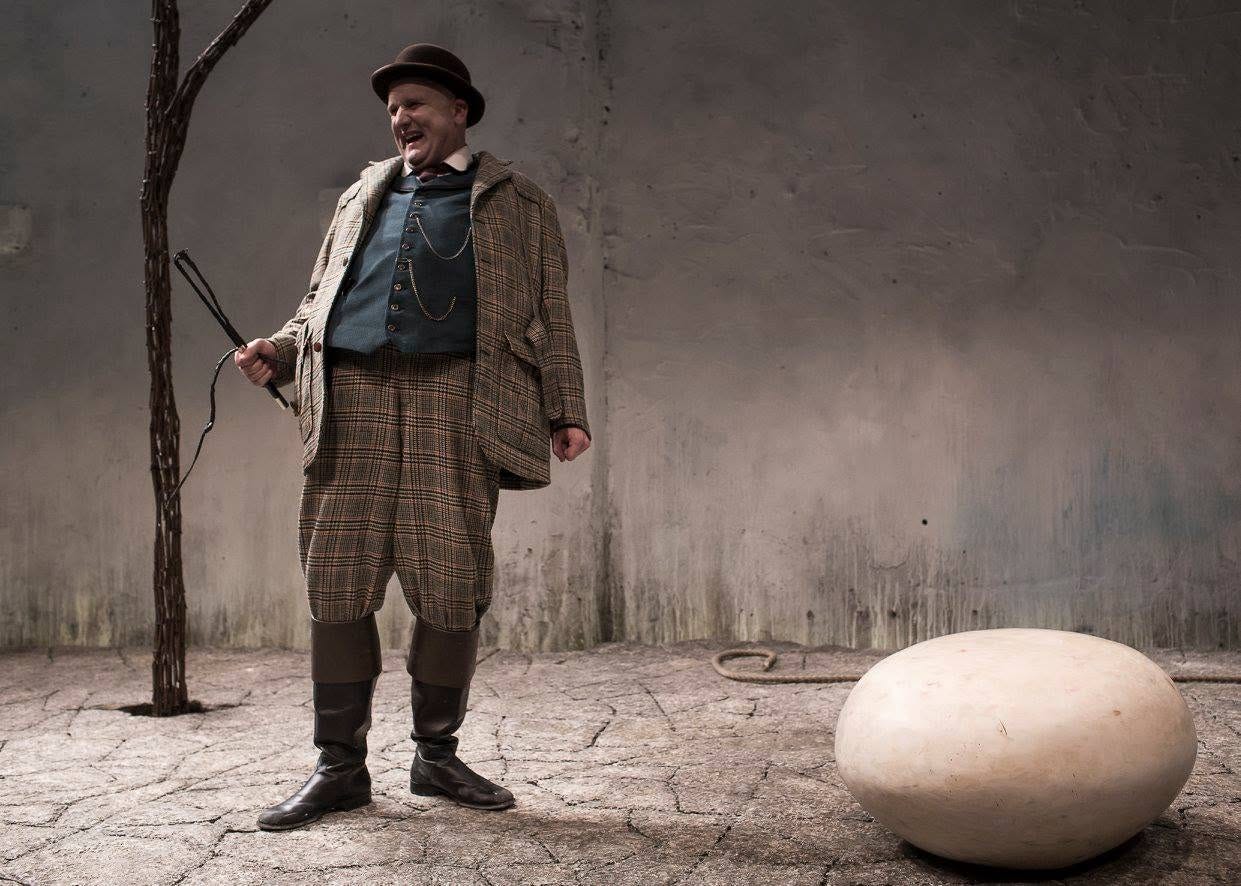
Rory Nolan’s movement from Pozzo to Corry Kinchela exposes another continuity. Both characters represent power, possession and theatrical authority. Pozzo arrives leading Lucky by a rope. He controls movement, food, speech and the conditions under which another person may rest or think. His authority is at once brutal and performative. He needs spectators, an audience looking at him. He announces himself, displays his possessions, gives orders and stages Lucky’s dance and speech for Vladimir and Estragon.
Kinchela similarly treats people and land as things that can be possessed, or at least, things that he can possess. His power depends on the manipulation of law, property, information and his brute physical force. He is the villain required by the moral architecture of Boucicault’s play. He is the source of injustice whose exposure permits the restoration of order. If Pozzo appears monstrous, his monstrosity cannot be resolved so easily. He is not exposed and punished. Indeed, when he returns blind in the second act, the relationship between master and servant persists. But can we say that he has been punished?
The world has changed without becoming more just.
Order merely shifts its position.
It does not work its way towards resocliton.
There is no law or justice in Beckett’s world.
Kinchela belongs to a drama that can still isolate evil in an individual. Pozzo belongs to a theatre in which domination has become a structural feature of a world in flux.
Here again, Beckett does not necessarily reject Boucicault’s melodrama.
He removes its mechanism of moral resolution. The villain is no longer defeated because there is no longer a stable community capable of judging him. Pozzo comes and goes. Lucky remains tied to him. Vladimir and Estragon watch, object briefly and then return to waiting.
Druid’s ensemble casting enables these relationships to pass through the actors’ bodies. Monaghan, Rea and Nolan carry one play into the other. The same physical contrasts recur: the smaller comic survivor, the taller figure who attempts to maintain meaning, and the expansive man of power who enters their world. The comparison reminds us that Waiting for Godot is not only a philosophical drama about universal existence. It is also an Irish play containing recognisable residues of popular theatre: the comic pair, the wandering rogue, the landlord or master, the abused servant, the mysterious appointment, the delayed arrival and the repeated promise of deliverance.
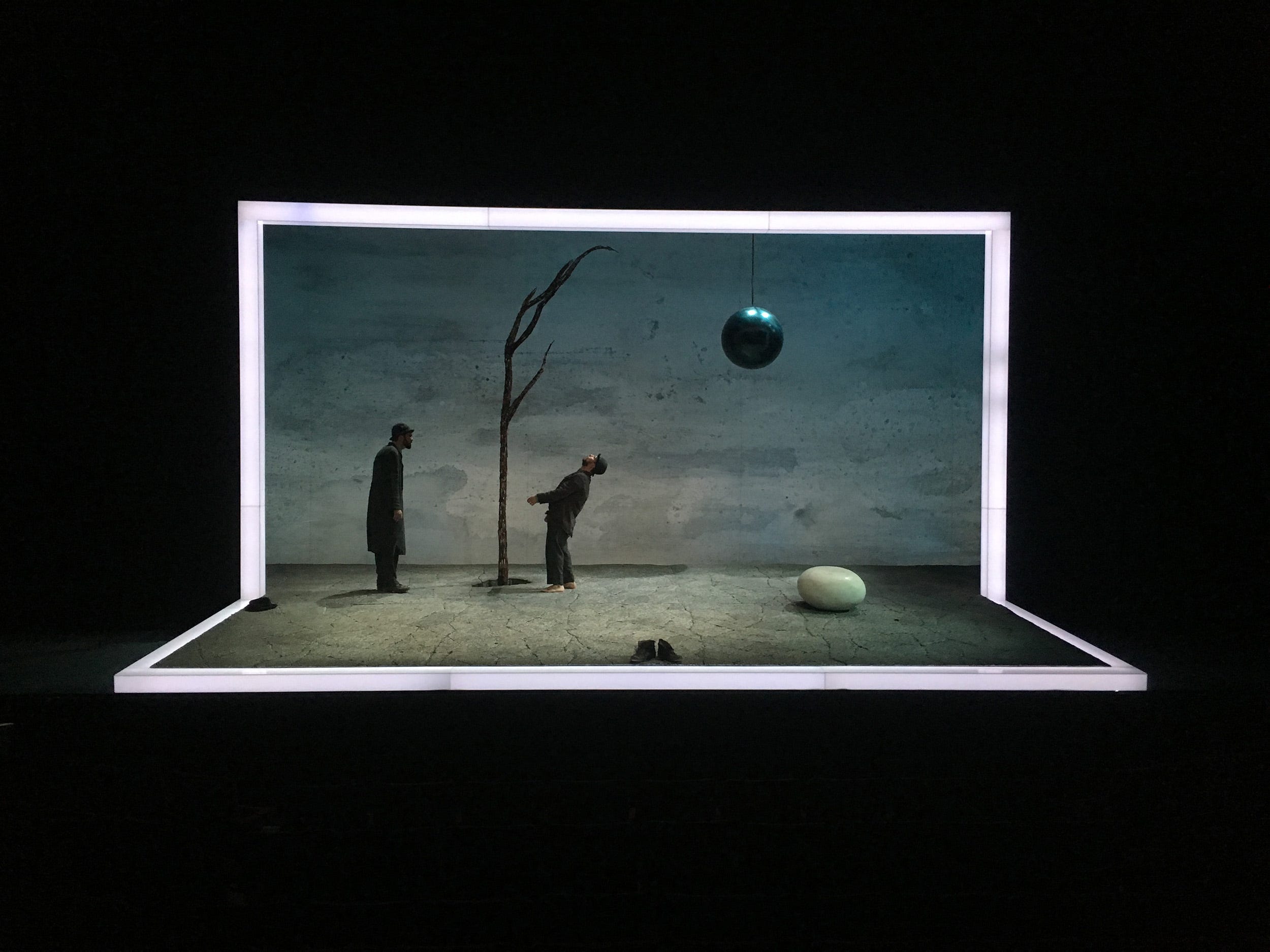
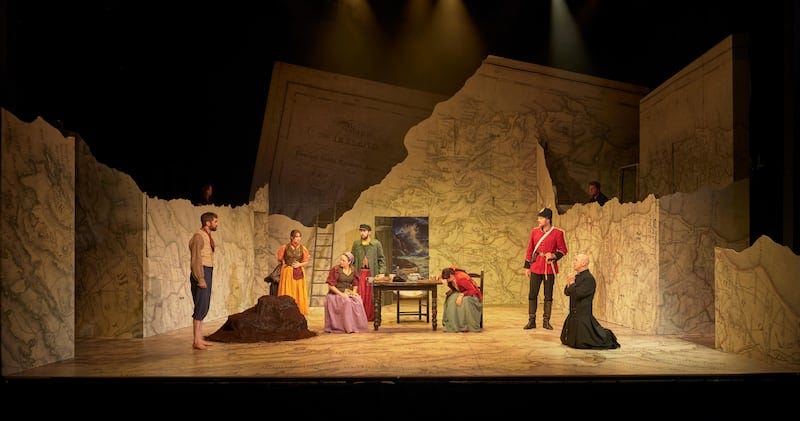
The overlap between the two productions extends beyond casting into Druid’s visual language. Francis O’Connor’s design for The Shaughraun reuses the moon created for the company’s 2016 Waiting for Godot.
“It’s Druid’s moon”, O’Connor remarks, a practical consequence of the company’s commitment to reusing scenery, but also a suggestive act of theatrical inheritance. In Godot, the moon rises abruptly over a barren road, marking the arrival of night and the repetition of another unfulfilled day. The Irish Times described it as “smooth and reflective as a marble”, its appearance changing the emotional temperature of the production.
In The Shaughraun, that same moon now hangs above a theatrical world crowded with landscape, action, pursuit and escape. The object carries the memory of Beckett’s emptiness into Boucicault’s abundance. Hynes has said that the production brings “everything theatre has learned since Boucicault back into the room,” and the moon makes that process materially visible.
Boucicault is not reconstructed as though Beckett had never happened but staged through a directorial and design vocabulary shaped by the theatre that followed him. We are looking backwards through time. The same celestial prop looks down on two radically different experiences of theatrical time—one in which night confirms postponement and another in which darkness provides cover for action, deception and eventual rescue.
Beckett’s stage is often described as empty. But perhaps it is better understood as a stage from which an earlier Irish drama has recently departed. The road, the tree and the waiting figures are what remain after the houses, estates, lovers, policemen, villains, dogs and rescue plots have been taken away.
This is what it means to consider Boucicault after Beckett. We do not need to claim that Boucicault anticipated absurdism or that Beckett consciously rewrote The Shaughraun. Rather, Beckett teaches us to notice the anxiety concealed inside melodramatic certainty. Every rescue depends upon a period in which rescue may not happen. Every return contains the possibility that the absent person will remain absent. Every apparent resurrection asks the audience to imagine, however briefly, that the dead may stay dead.
Boucicault uses that anxiety and then releases us from it.
Beckett refuses the release.
In Boucicault, someone arrives in time.
In Beckett, someone may arrive tomorrow.
Or never.
In The Shaughraun, absence is temporary. Robert returns from transportation. Conn survives apparent death. Kinchela’s plot is uncovered. Lovers are reunited and the disordered community is repaired. The theatrical machine works with extraordinary efficiency, pulling the characters back from catastrophe before the curtain falls.
In Waiting for Godot, the machine is still running, but the rescue has been removed. Estragon and Vladimir continue to perform the preliminary business of melodrama. They wait for the important arrival. They exchange information, encounter strangers, consider escape and prepare themselves for a change in fortune. A messenger even comes at the end of each act. But he brings only postponement. The message that would once have set the final rescue in motion now announces that the play must begin again.
In Boucicault, someone arrives in time.
In Beckett, someone may arrive tomorrow.
The achievement of Druid’s two productions is to allow both theatrical worlds to inhabit the same performers. Conn stands behind Estragon, as Estragon now stands behind Conn. Robert’s successful return haunts Vladimir’s unsuccessful waiting. Kinchela’s exposure throws Pozzo’s continuing power into sharper relief. Boucicault’s crowded stage and Beckett’s empty one becomes not opposites, but different states of the same theatrical tradition.
After Beckett, The Shaughraun can no longer be dismissed as a naïve melodrama that believes too easily in rescue. Its exuberance becomes poignant because we have seen what remains when rescue is no longer possible.
After Boucicault, Waiting for Godot may appear less like the beginning of an entirely new theatre than the ghost of an older one. Irish melodrama after the hero has failed to arrive, the villain has escaped punishment, and the curtain has forgotten how to fall.
Farce and failure.
And don’t forget the food.
Yours in Irish food,
Jp.
23rd July.
Note
This article is part of a series that tries to highlight food in the other spaces of the arts in Ireland. Bringing food into this space highlights the cultrual role and significance of food in Ireland more than just as a commodity or an object of sustenance and nutrition.
See Eileen T O’Halloran, From Boucicault to Beckett: Irish modernism and the myth of Mother Ireland (The University of Wisconsin, PhD Thesis 2004).
The Pozzo scene split into labour, consumption and waste is the part I'll be carrying into kitchens. That division isn't only theatrical. It's the oldest arrangement in any restaurant: who carries the basket, who eats, and what's left for the person who did the carrying.
The kitchens I trust most are the ones where the staff meal answers it well.
Loved this. Ideas swimming now. Thinking about Modernity deteriorating indigenous connection. (Thinking about how Vanessa de Machado de Oliveira’s grandmother was worried her prospective husband wouldn’t know how to laugh - at everything.)
This essay has helped me receive Beckett. It makes me feel the grief of Godot even more, rather than only the teasing to frustration boring and painful numbing of a cruel world. I can sense the ghosts now. Shaughran feels like a wild romp but this essay affirms something - a farce of a farce. With Godot in the rear view mirror, the melodrama knows what is at stake. Not over the top angst but real dismantling of a culture. The threat that one day the highjinks will not succeed - or only in the theatre. The jokes won’t ricochet because a farce without structure - or set - no doors slamming or pop ups from behind props - is flat. The laughter can’t keep circling like Irish tunes on the fiddle where one song becomes another becomes another because the violin isn’t there anymore. But the memory of it is. Like the memory and promise of the feast. The promise is anxious. Loved this essay thank you. Think we need a writer, you?, to write a climate/poly crisis, food farce with a thrutopian twist but how would the gags work? You will figure it out! Xxxx
Maybe it’s set on a farm? And we actually farm while we receive? Is there life in the land yet? Is there a moon? Druid’s and a druid’s and ours? 🤷♂️